

Centre-Filled, Dual-Material & Partial-Fill Extrusion Forming
New Options in Extrusion Forming: Centre-Filled, Dual-Material Composite and Partial-Fill Forming Now Available
Why Innovation Is the Growth Driver
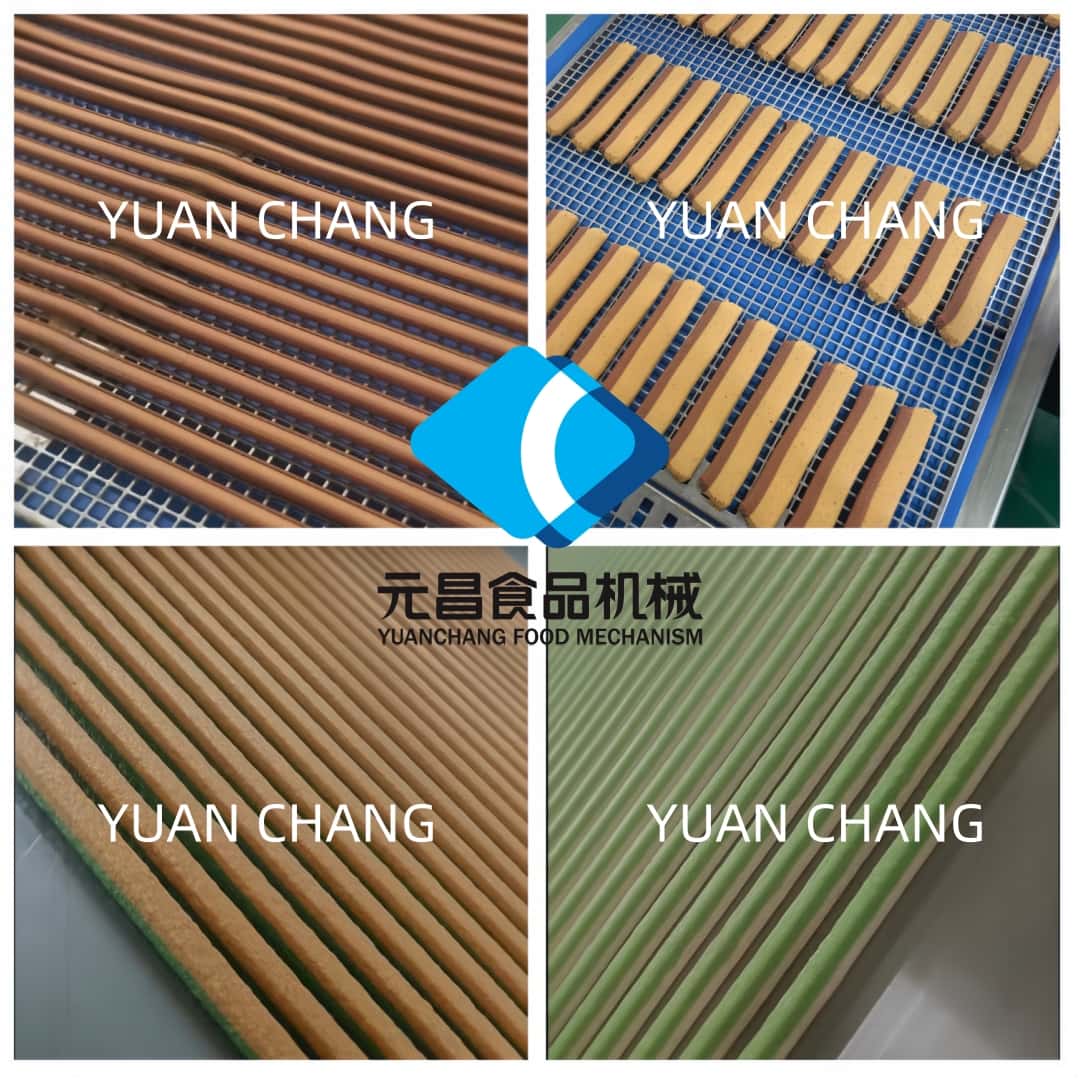
In recent years, competition in the high-protein meat snack and pet treat markets has shifted from "who has one" to "what makes it different". Consumers and buyers alike are looking for products with a stronger point of difference: a cheese-filled meat strip that stretches when bitten, a dual-texture meat bar with a different bite outside and in, or a partial-fill snack with a more distinctive appearance and mouthfeel. On the road towards product diversification, we continue to invest in product development, working to solve production challenges for customers with different requirements.
Extrusion-formed products place new demands on the forming process, and the technology has been upgraded across the board: multi-lane extrusion uniformity and stability, hygiene and cleanability, and the ability to handle different materials and visual effects.
Three New Forming Processes Added in 2026
Building on the existing multi-lane (single-material) extrusion forming technology, we have added three new forming processes to the extrusion forming equipment in 2026. All three have been validated on customers' production lines and can support a wide range of custom configurations:
Centre-Filled Forming (Centre-Filled Co-Extrusion): While the outer material is extruded continuously, the filling (cheese, paste, etc.) is injected simultaneously through a concentric inner nozzle, creating a fully continuous filled structure. Suited to filled meat strips, filled pet treats and similar products.
Dual-Material Composite Forming (Dual-Colour / Dual-Texture Forming): Two materials are combined within a single cross-section, enabling dual-colour, dual-texture and meat-plus-plant combinations. The cut surface shows a clear left-right (or top-bottom) layer boundary, ideal for developing visually differentiated products.
Partial-Fill Forming (striped / swirl core): The filling is injected at a set ratio, producing an off-centre or striped filling distribution. It retains the visual appeal of a filled product while allowing flexible configuration for different product positioning.
Technical Implementation: The Step from Single to Multi-Material
These three processes are far more than "adding another pipe". They represent a series of upgrades to the established extrusion forming system:
Co-extrusion die: A concentric dual-channel design in which the outer material and the filling are conveyed independently and converge at the die outlet. The ratio between outer layer and filling is adjusted by changing die components, matching different recipes and product positioning.
Synchronised dual-line feeding: Extrusion pressure and flow rate of the outer material and the filling are each regulated by closed-loop control, keeping the composite cross-section consistent over long continuous production runs - the key to stable filled products.
Multi-stage material distribution: From the vacuum filler to the forming station, material is distributed evenly across the lanes through a distribution manifold, with uniformity and stability maintained in every lane.
Modular assembly: The divider and die head can be removed without tools for easy cleaning, and the system supports high-pressure washing for hygienic cleaning with no dead spots.
Compatibility with Existing Lines
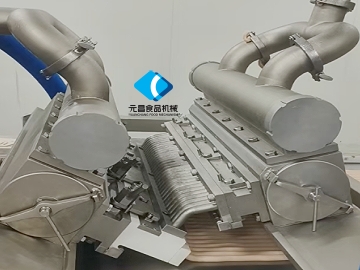
The three new processes are built on the multi-lane extrusion forming line platform: the vacuum filler, the flexible lane-dividing system, and the cutting and recipe management controls all follow the existing architecture. Customers already running extrusion forming equipment can evaluate an upgrade on their existing line, while new customers can specify single-material, centre-filled, dual-material or partial-fill configurations from the planning stage.
The line retains its hygienic, easy-strip-down design: the divider removes as a single unit, the die head is one replaceable component covering different forming sizes, and the machine as a whole is designed and manufactured to food-contact requirements.
Who Is It For?
Snack brands: Develop filled, dual-texture and other differentiated products to move away from homogeneous price competition.
Pet food manufacturers: Filled pet treats that combine a chewy outer layer with a flavour-rich filling are a well-established route to higher price points.
Convenience food producers: Dual-colour composites and striped-core formats serve as differentiated ingredients for ready-to-eat snacking channels.
Contract manufacturers (OEM/ODM): One line covering multiple forming processes, with changeover by recipe recall and die-head swap - well suited to fast-turnaround contract production.
Availability and Enquiries
The new forming processes are now available as selectable options or custom configurations on the extrusion forming equipment. When enquiring, it is helpful to provide: target product type and size, the approximate form of the outer material and filling (viscosity, particulate content), target output, and whether an upgrade to an existing line is required. The engineering team will then propose a customised configuration and line layout.
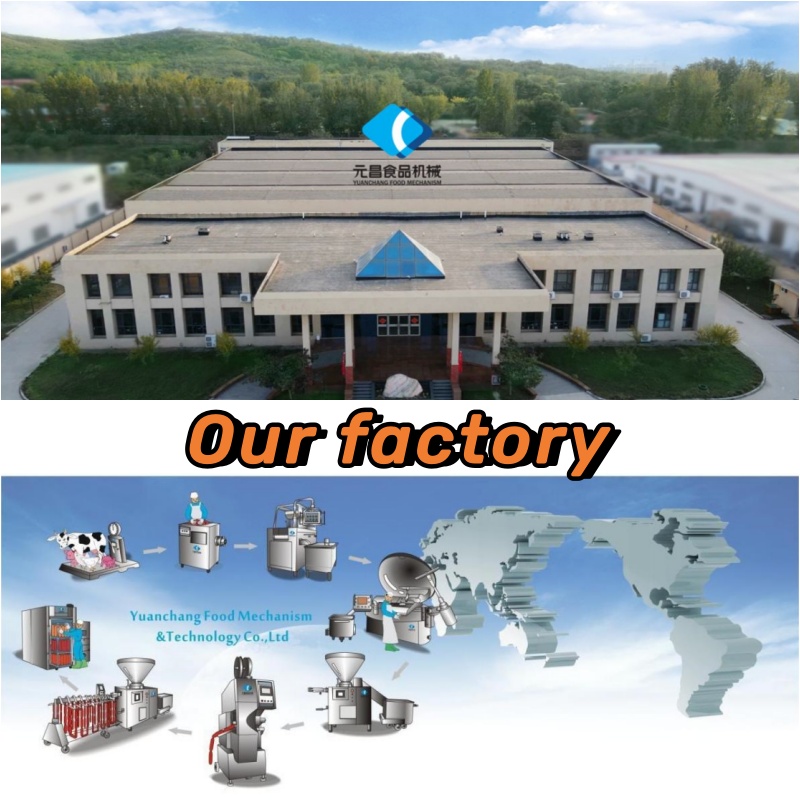
Hebei Yuanchang Food Mechanism & Technology Co., Ltd. has implemented the three forming processes described above on its multi-lane extrusion forming platform, and all have been validated on production lines in the field. The machines are designed and manufactured to food-contact requirements. Founded in 1986, Yuanchang specialises in meat and pet food processing equipment. Its products are CE and EAC certified, and the company has more than 20 years of experience exporting to many countries and regions worldwide.