

Comprehensive Analysis of Meat Product Quality: Processing Technology, Process Control and Future Trends
Comprehensive Analysis of Meat Product Quality: Processing Technology, Process Control and Future Trends
Why Does Processing Technology Determine Meat Product Quality?
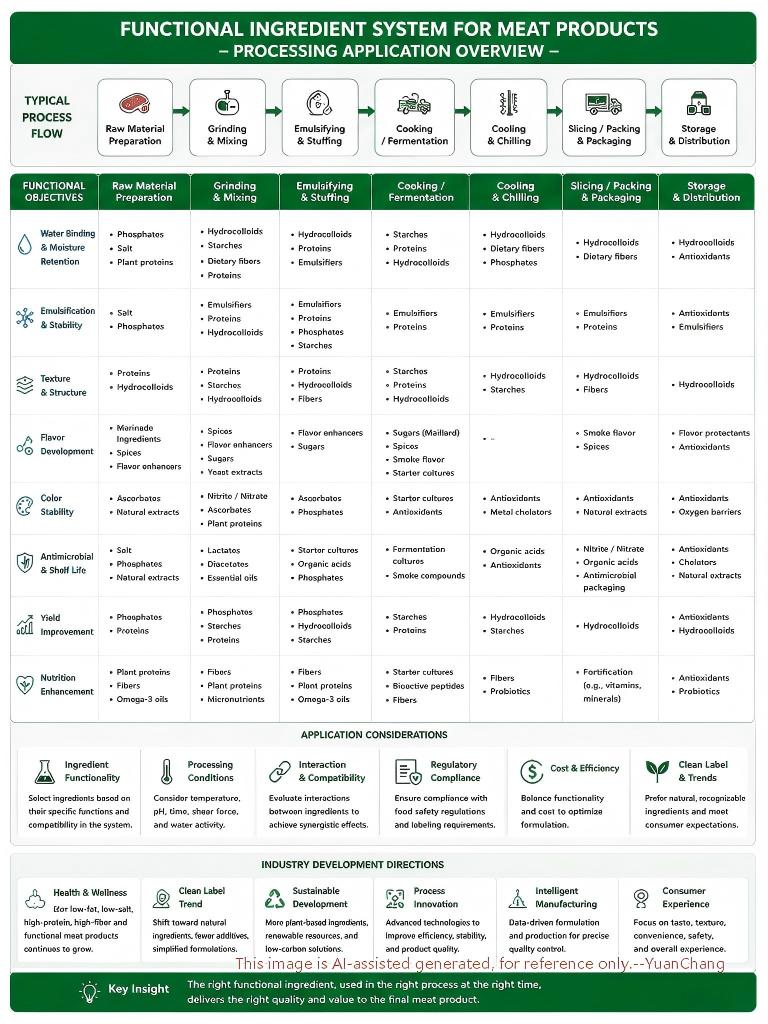
In modern meat processing, product quality is no longer determined solely by raw materials or formulations. High-quality meat products depend on the effective combination of raw material functionality, processing technology and production stability.
Drawing on decades of practical experience in meat processing equipment and production line solutions,
Hebei Yuanchang Food Machinery has observed that advanced processing technologies are essential for improving
product consistency, production efficiency, and long-term operational stability.
Advanced processing technologies help manufacturers minimize ice crystal damage, protein denaturation,
moisture loss and fat separation during production. By combining optimized formulations with intelligent
processing equipment, manufacturers can achieve:
• Higher product yield
• Improved water retention
• Reduced cooking loss
• Better texture and flavor consistency
• Extended shelf life
• Stable industrial production
Higher product yield
Improved water retention
Reduced cooking loss
Better texture and flavor consistency
Extended shelf life
Stable industrial production
For both whole-muscle products and emulsified sausage products, processing technology plays a critical role in determining final product quality.
1. What Is Marination and Extraction Technology?
Marination is one of the most important processes in meat manufacturing. Its primary function is to improve protein extraction, water retention and flavor distribution.
Vacuum Tumbling
Vacuum tumbling is the mainstream industrial solution used by modern meat processors.
Under vacuum conditions and low temperatures (typically 0–4°C), mechanical action helps disrupt muscle fibers and promotes protein swelling and extraction.
Benefits include:
Improved water-holding capacity
Better protein extraction
Enhanced texture and sliceability
Higher product yield
More uniform seasoning distribution
Injection Marination
Injection systems deliver brine directly into muscle tissue, improving curing uniformity and reducing processing time.
Key control factors include:
Injection percentage
Brine viscosity
Needle distribution
Product temperature
Advanced Marination Technologies
Modern technologies include:
High Pressure Processing (HPP)
Ultrasound-assisted marination
Vacuum-assisted marination
These technologies improve mass transfer efficiency and tenderness while contributing to product safety and shelf-life extension.
Frequently Asked Questions
What is the recommended temperature for vacuum tumbling?
Most industrial processors operate between 0°C and 4°C to maximize protein functionality while maintaining food safety.
Why is vacuum tumbling important?
It improves protein extraction, water retention, texture and yield while reducing process variability.
2. What Is Meat Tenderization Technology?
Tenderization improves product texture by modifying muscle structure.
Mechanical Tenderization
Common methods include:
Blade tenderization
Needle tenderization
Ultrasonic treatment
High-pressure processing (150–400 MPa)
These methods break down muscle fibers and connective tissues, improving tenderness and eating quality.
Enzymatic Tenderization
Enzymes such as:
Papain
Bromelain
are widely used to hydrolyze muscle proteins.
Careful process control is required because excessive enzyme activity may result in undesirable soft texture.
Chemical Tenderization
Chemical methods may involve:
Sodium carbonate
Calcium salts
Polyphosphates
These ingredients help regulate pH, activate endogenous enzymes and improve water-holding capacity.
Frequently Asked Questions
What factors affect meat tenderness?
Muscle structure, pH value, enzyme activity, mechanical treatment and processing temperature all influence tenderness.
3. What Is Fermentation Technology?
Fermentation is a critical technology used in dry and semi-dry sausage production.
Selected starter cultures help improve product safety, flavor and color development.
Common microorganisms include:
Lactobacillus plantarum
Lactobacillus casei
Staphylococcus xylosus
Benefits include:
Lower pH
Reduced water activity (Aw)
Improved microbial stability
Enhanced flavor complexity
Better color stability
Processing Challenges
Mixed-strain fermentation often produces superior sensory characteristics but requires strict control of:
Temperature
Relative humidity
Fermentation time
Starter culture selection
Improper control may increase the risk of biogenic amine formation.
Frequently Asked Questions
Why is fermentation important in dry sausage production?
Fermentation improves food safety, shelf life, flavor development and color stability.
Why Is Thawing Technology Important?
Thawing is often overlooked but significantly affects downstream processing performance.
Traditional water thawing or air thawing can cause excessive drip loss, leading to the loss of proteins, minerals and flavor compounds.
Modern solutions include:
Microwave thawing
Radio-frequency thawing
Vacuum steam thawing
Proper thawing helps maximize water retention and improves subsequent tumbling and mixing performance.
Future Trends in Meat Processing Technology
Clean Label Products
Manufacturers are gradually reducing the use of phosphates, artificial hydrocolloids and synthetic preservatives while adopting:
Citrus fiber
Natural antioxidants
Fermentation-based preservation systems
Health-Oriented Formulations
Future products are increasingly focused on:
High protein
Low fat
Reduced sodium
High dietary fiber
Hybrid formulations combining animal and plant proteins are becoming more common.
Digitalization and AI Manufacturing
Modern meat processing facilities are adopting:
MES systems
Online pH monitoring
Online Aw monitoring
Automatic recipe management
AI quality prediction systems
These technologies help reduce batch-to-batch variation and improve process consistency.
Conclusion
Modern meat product quality is determined by the interaction of raw materials, formulations, processing technologies and intelligent equipment.
Successful manufacturers understand that product quality is not achieved through ingredients alone, but through the precise control of mechanical action, thermodynamic processes and processing parameters throughout the entire production cycle.
By integrating advanced processing technologies with intelligent equipment solutions, meat processors can improve yield, consistency, product quality and long-term profitability.
Drawing on decades of experience in meat processing equipment and production line solutions, Hebei Yuanchang Food Machinery believes that the future of meat manufacturing lies in the effective integration of scientific process control, intelligent equipment, and data-driven production management. Through its Knowledge Center, Hebei Yuanchang Food Machinery will continue to share practical insights on meat processing technology, equipment applications, and industry trends with food manufacturers worldwide.