


The Ultimate Guide to Industrial Meat Tumbling: Maximizing Yield, Tenderness, and Process Standardization
Published: September 2019 | Last Updated: June 2026
In the commercial meat processing industry, tumbling and massaging is a critical phase for producing high-quality hams, bacon, and poultry products. By utilizing a heavy-duty commercial meat tumbler, raw meat undergoes a process of continuous rolling, dropping, and friction. This mechanical action allows marinating agents, brines, and seasonings to penetrate the muscle fiber tissue rapidly and uniformly, drastically boosting curing efficiency and color development.
Understanding the science of tumbling methods and key parameters like Tumbling Stroke is essential for any food processing plant looking to scale production, improve product texture, and maximize profit margins.
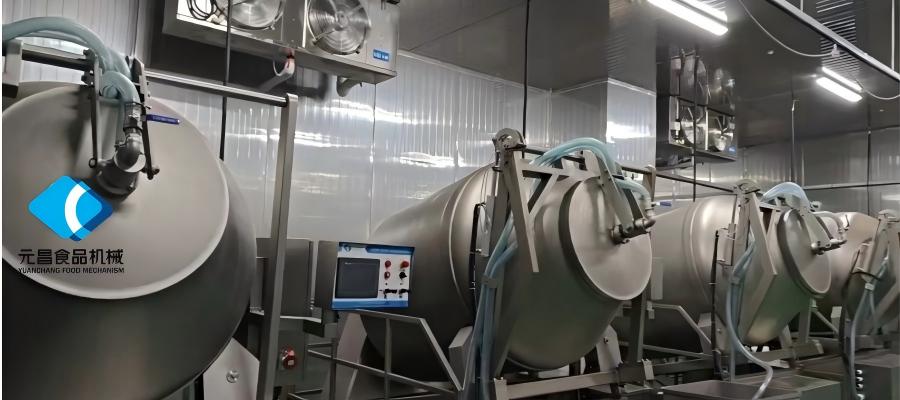
1. The Science of Meat Tumbling: Breaking Fiber & Maximizing Yield
Using the principles of physical impact, meat pieces repeatedly drop and rub against each other and the drum walls. This targeted mechanical stress results in muscle relaxation and the controlled breakage of myofibrils, offering distinct manufacturing advantages:
Accelerated Brine Absorption: The penetration rate of the marinating solution increases drastically, shortening the overall curing cycle.
Uniform Moisture Distribution: Injected saltwater is evenly distributed throughout the meat matrix, enabling the muscle tissue to hold a significantly larger volume of water.
Enhanced Product Quality: This dual action significantly improves both final product yield and sensory tenderness.
Mechanical Impact ➔ Myofibril Breakage ➔ Optimal Protein Extraction ➔ Superior Binding
The Role of Salt-Soluble Proteins
During tumbling, the friction, impact, and extrusion cause salt-soluble proteins (such as myosin) to extract and migrate to the meat's surface. As tumbling time progresses, these proteins dissolve further, absorbing water and starch to form a sticky, natural protein paste. This paste acts as a critical binding agent, seamlessly fusing different meat pieces together during cooking, improving sliceability, and reducing cooking loss.
2. Optimizing Tumbling Methods: Intermittent vs. Continuous & Directional Control
The choice of motion profile inside the drum directly determines the quality and uniformity of your final product.
Intermittent Tumbling vs. Continuous Tumbling
When total tumbling time and drum speed are identical, intermittent tumbling (cycles of tumbling followed by rest periods) increases product yield by approximately 2% to 3% compared to continuous tumbling, while delivering a more uniform cured color.
The Static Advantage: During the rest (static) phase of intermittent tumbling, the brine continues to permeate deeply. The muscle cells fully hydrate and expand, leading to superior tenderness.
Protein Extraction: This method enhances the extraction of salt-soluble proteins, ensuring excellent meat cohesion and minimizing cooking loss.
One-Way vs. Two-Way (Bi-directional) Tumbling
While alternating between clockwise and counterclockwise rotation shows no drastic difference in absolute chemical yield, two-way (bi-directional) tumbling delivers a 1.5% higher yield and significantly better slice quality than one-way tumbling. Bi-directional movement ensures a higher uniformity of physical impact, eliminating blind spots inside the drum.
3. Mastering the Tumbling Stroke: The Formula for Standardization
In mass production, measuring a cycle simply by "tumbling time" is inaccurate due to variations in machine sizes, drum configurations, and rotational speeds. Instead, the industry relies on the Tumbling Stroke to measure the actual physical work applied to the meat.
The Tumbling Stroke Formula
To standardize your production line, use the following calculation:
$$L = C \times R \times t$$
Where:
$L$ = Tumbling Stroke (Total distance traveled in meters)
$C$ = Inner circumference of the tumbler drum ($\pi \times \text{diameter}$)
$R$ = Rotational speed of the tumbler (RPM / revolutions per minute)
$t$ = Active tumbling time (excluding rest periods in intermittent cycles)
+--------------------------+----------------------------+
| Meat Piece Size/Type     | Recommended Stroke (L)     |
+--------------------------+----------------------------+
| Large Pieces (>10 cm)    | 14,000 m – 16,000 m        |
| Medium Pieces (~5 cm)    | 10,000 m                   |
| Minced/Ground (3-6 mm)   | 1,500 m – 2,000 m          |
+--------------------------+----------------------------+
Note: Correctly managing and extending the tumbling stroke according to these specifications minimizes product wear and tear while maximizing moisture retention.
The Risks of Improper Tumbling Cycles
Under-Tumbling (Stroke too short): Muscle tissues remain tight and cannot fully absorb the brine. This leads to insufficient protein extraction, uneven internal coloring, poor meat cohesion, and structural crumbling when sliced.
Over-Tumbling (Stroke too long): Excessive mechanical stress causes the salt-soluble proteins to denature. This breaks down the protein network, destroying the meat's water-binding capacity and leading to excessive purging, oil separation, and poor texture.
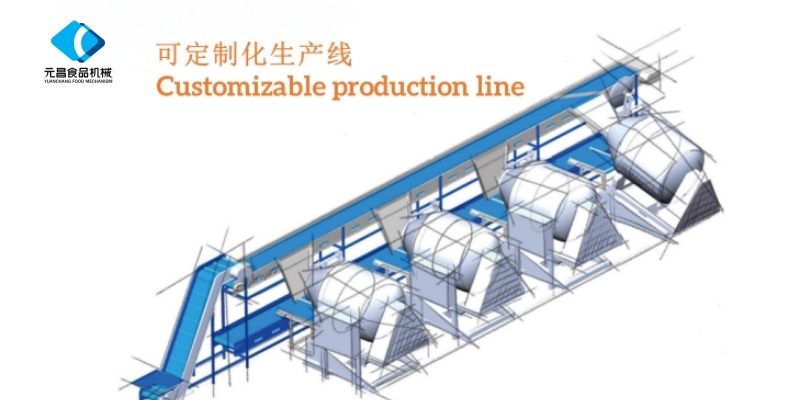
4. Advanced Technology: Low-Temperature Vacuum Tumbling
Today, integrating temperature control with a vacuum environment has become the global benchmark for food safety and product quality.
To maintain the structural integrity of the meat, industrial horizontal tumblers operate under strict temperature-controlled environments. This is achieved by placing the machines in a 4–8°C cold storage room, or by using advanced tumblers equipped with refrigerated cooling jackets or cooled internal paddles.
During the process, maintaining a high vacuum level (typically around -90 kPa depending on product lines and altitude) delivers essential operational benefits:
Suppressed Microbial Growth: The lack of oxygen inhibits the growth and reproduction of aerobic spoilage bacteria and harmful microorganisms, extending shelf life.
Texture & Bubble Control: Vacuum environment prevents air from being whipped into the meat matrix, reducing temperature spikes from friction and eliminating micro-bubbles that cause pocket defects in sliced meats.
💡 Professional Conclusion:
Achieving perfect meat texture, taste, and water-oil retention requires a systematic approach. The final quality of low-temperature meat products is a balanced equation of tumbling mode, raw meat size, tumbling stroke, load capacity, vacuum level, and temperature control. Investing in automated, highly precise vacuum tumbling equipment is the key to achieving standardized, repeatable product quality.
