

Yuanchang ZSJ Brine Injectors: Pre-Tumbling Technology Meets European Injection Standards
First published August 2026.
In meat processing, the brine injection stage determines product yield, tenderness, flavour distribution and shelf life. An inconsistent injection cannot be compensated for by downstream tumbling, cooking or smoking. The Yuanchang ZSJ series of meat emulsion and brine injectors is designed around this single critical stage, combining the European injection process requirements — constant linear speed, adjustable injection depth and pressure stability — with nearly half a century of pre-tumbling research to provide processors with a repeatable, traceable injection solution.
This article first reviews the process principles and literature behind pre-tumbling technology, then explains how the ZSJ series supports this process at the hardware and control system level, and concludes with the three-model range, application scenarios and integrated production line configurations.
1. Pre-Tumbling: A Process Studied for Half a Century
As early as the 1970s, a substantial body of international literature reported on the effects of tumbling technology on meat product quality. In recent years, research focus has shifted towards pre-tumbling — the short-duration tumbling of raw meat prior to brine injection or blade tenderising.
The core mechanism of pre-tumbling lies in improving the flexibility of muscle tissue. During tumbling, the muscle fibre structure relaxes, creating more favourable physical conditions for brine penetration and retention in the subsequent injection stage. This manifests in three aspects:
· Higher brine retention — during post-injection tumbling, the volume of brine held within the muscle tissue increases, correspondingly raising product yield.
· Reduced total massage time — the pre-tumbling step lessens dependence on downstream tumbling duration, shortening the overall line cycle.
· Improved brine permeability — with relaxed muscle fibres, brine diffuses more uniformly through the meat, reducing the risk of localised over-salting or under-salting.
The literature also notes that pre-tumbling has a positive effect on the yield and tenderness of roast beef, but no significant effect on expressible moisture content. Some studies indicate that pre-injection tumbling does not affect most evaluation indices of vacuum-conditioned steamed beef; if post-injection tumbling time is extended to 10 hours, brine distribution and product appearance may improve and the shear force of steamed beef may decrease, but quality loss during post-injection tumbling and pasteurisation stages increases. In other words, pre-tumbling is not a universal remedy; its value depends on whether the injection stage itself can deliver a stable, uniform brine distribution.
2. Three Requirements of European Injection Technology
European meat processors evaluate brine injection equipment against three core criteria:
· Constant linear needle speed — the downward travel speed of the injection needles through the meat must remain consistent, avoiding localised over- or under-injection.
· Adjustable and repeatable injection depth — different products (bacon, ham, roast meat) require different injection depths; the machine must switch between these at the recipe level rather than through mechanical adjustment.
· Injection pressure stability — pressure fluctuations directly cause uneven brine distribution, affecting yield and texture consistency.
The ZSJ series addresses each of these three requirements in its design: a servo-driven system maintains constant needle bridge descent speed; the recipe programme sets product height and injection depth, enabling product changeover without mechanical adjustment; injection pressure is adjustable within the 0.4–1.0 MPa range, combined with customisable step pitch, accommodating the full spectrum from thin bacon to thick meat blocks.
3. ZSJ Series: Modular Design and ICS Intelligent Control
The ZSJ series comprises three models — ZSJ-72, ZSJ-180 and ZSJ-360 — covering a production capacity range of 0.5–8 tonnes per hour. The new ZSJ-180 and ZSJ-360 incorporate three key structural upgrades:
3.1 Modular Needle Bridge — Quick Changeover and Easy Cleaning
The injector needle bridge features a modular design that can be replaced as a complete unit. When different products require different needle arrangements, spacing or bore sizes, the operator can swap the needle bridge in minutes without recalibrating the entire machine. The needle bridge and all product-contact parts support CIP (Clean-in-Place) cleaning, reducing downtime between product changeovers.
3.2 Recipe-Based Parameter Management — No Mechanical Adjustment for Product Switching
Product height, injection depth, injection pressure, step pitch and injection speed are all configured within the recipe programme. Switching from bacon to ham, or from thin to thick meat blocks, requires only recalling the corresponding recipe — no mechanical limit adjustments or cam changes are needed. This design allows a single production line to rotate through multiple SKUs, improving equipment utilisation.
3.3 ICS Intelligent Control System — Upstream and Downstream Integration
ICS (Integrated Control System) is the intelligent control core of the ZSJ series. It manages the injector’s own motion logic whilst coordinating with upstream raw meat preparation and downstream tumbling, tenderising, cooking and pasteurisation equipment. CIP cleaning systems and dynamic weighing of inbound and outbound materials can be integrated, providing a hardware foundation for production data traceability.
4. Meat Emulsion Injection: Extending Traditional Brine Injection
The ZSJ series handles not only traditional brine injection but also meat emulsion injection — a newer process in which a fine meat emulsion paste is injected directly into the centre of meat blocks. This is a more demanding process route: the viscosity of meat emulsion is far higher than that of brine, placing different requirements on injection pressure, needle structure and pipeline conveyance.
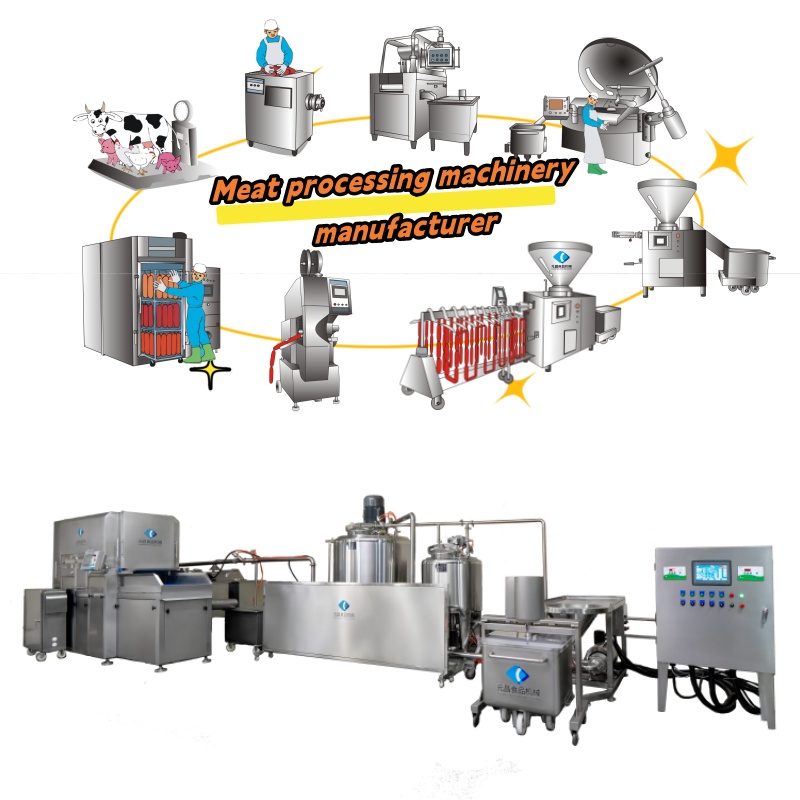
The complete meat emulsion injection process comprises: emulsion preparation → chilling → injection → re-emulsification and tenderising → pasteurisation, forming an integrated production line. This route, whilst retaining traditional brine injection capability, helps increase the meat content of the product, improves finished product quality, supports longer shelf life, and achieves automated production through the ICS control system, seamlessly linking upstream and downstream operations.
5. Technical Specifications
Core specification comparison across the three ZSJ models:
Model | Capacity (T/h) | Power (kW) | Injection Pressure (MPa) | Working Stroke (mm) | Injection Speed (strokes/min) | Needle Count | Step Pitch | Injection Rate (%) | Hopper Volume (L) | Dimensions (mm) |
ZSJ-72 | 0.5–1 | 5.3 | 0.4–1.0 | 120 | 16/24 | 72 | 10–80 | 60–80 | 110 | 1450×900×1700 |
ZSJ-180 | 3–5 | 13.5 | 0.4–1.0 | 30–190 | 10–65 | 180 | Servo-driven / Custom | 5–100 | 300 | 2980×1660×2165 |
ZSJ-360 | 4–8 | 21 | 0.4–1.0 | 30–190 | 10–65 | 360 | Servo-driven / Custom | 10–180 | 500 | 3350×1660×2165 |
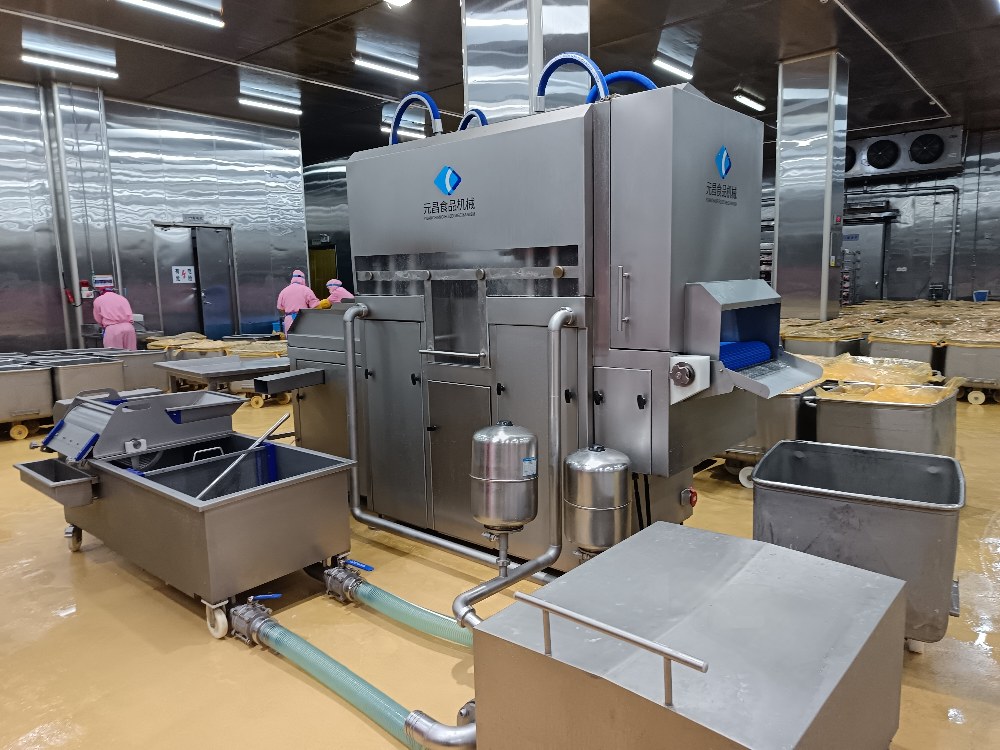
All three models share the same injection pressure range (0.4–1.0 MPa); the differences lie in needle count, production capacity, injection rate range and hopper volume. The ZSJ-72 suits small-batch multi-category workshops, whilst the ZSJ-180 and ZSJ-360 are built for medium to large continuous production lines. The injection rate range extends from 60–80% on the ZSJ-72 to 10–180% on the ZSJ-360, covering requirements from light seasoning to high-injection-rate products.
6. From Workshop to Large-Scale Plant
The three ZSJ models correspond to three production scenarios:
· ZSJ-72 (0.5–1 T/h, 72 needles) — small workshops or specialist product lines, suited to single-category precision injection.
· ZSJ-180 (3–5 T/h, 180 needles) — the primary model for mid-size processing operations; 5–100% injection rate handles standard ham, bacon and roast meat products, suited to multi-category rotation.
· ZSJ-360 (4–8 T/h, 360 needles) — large continuous production lines; 10–180% injection rate supports high-injection products, suited to multi-category rotation with broader application scope.
7. The Synergy Between Pre-Tumbling and the ZSJ Series
Returning to pre-tumbling — the literature indicates that the value of pre-tumbling depends on whether the injection stage itself can deliver a stable, uniform brine distribution. If the injector’s linear speed, injection depth or pressure stability fluctuates, the muscle tissue relaxation achieved by pre-tumbling may actually amplify the effects of inconsistent injection.
The ZSJ-180/360 series is designed to synergise with pre-tumbling at precisely this point:
· Constant linear speed — provides a consistent brine distribution foundation for pre-tumbled muscle tissue.
· Adjustable injection depth — accommodates varying meat block thicknesses after pre-tumbling, preventing shallow over-injection or deep under-injection.
· Pressure stability — in the relaxed state of the muscle tissue, prevents localised over-pressure that could cause brine to leach outwards.
In other words, pre-tumbling is the process precondition; the ZSJ series is the hardware guarantee for process execution. The significance of combining the two lies in making the literature findings — “higher yield, improved tenderness, reduced total massage time” — reproducible on an industrial production line.
Related Equipment
· Vacuum Tumbler — /products/vacuum-tumbler.html
· Vacuum Mixer — /products/vacuum-mixer.html
About Yuanchang
Hebei Yuanchang Food Mechanism & Technology Co., Ltd. was established in 1986 and manufactures meat processing equipment — bowl cutters, meat mincers, vacuum fillers, high-speed linking machines, brine injectors, vacuum tumblers and more — with CE and EAC certification and over 20 years of international cooperation experience. Every machine is designed around one principle: reliable day-after-day operation at full production speed. For more information, visit ycmeatmachine.com.
Note: The pre-tumbling process research cited in this article is drawn from published academic literature. Specific process parameters should be adjusted according to product type, raw meat characteristics and production line configuration. Equipment specifications and configurations are subject to change without notice due to continuous improvement. For the latest details, please contact our staff.